About this packaging
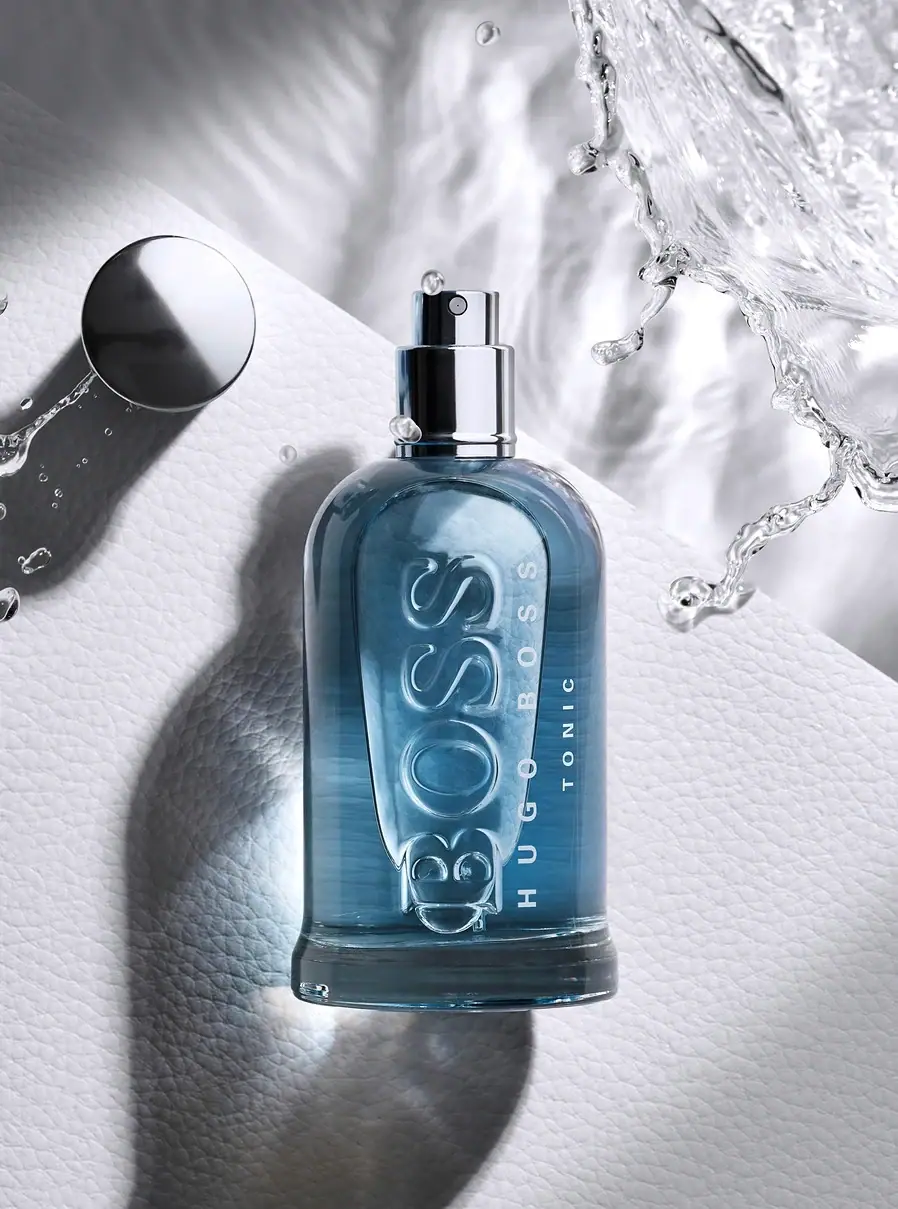
BOSS Bottled Tonic is shown as a rounded blue-toned transparent fragrance bottle with prominent dimensional-looking BOSS lettering and smaller pale identifiers. A reflective silver-toned cap sits detached beside the exposed silver-toned spray assembly; dark areas on the cap are reflections.
HUGO BOSS describes Bottled Tonic as a citrus-and-woody Eau de Toilette.[1]
Pack construction & use
- Container
- The official product page confirms a 100 ml BOSS Bottled Tonic bottle. The image shows a clear blue body with a heavy-looking base; do not infer substrate from the image.[1]
- Closure
- A silver-toned atomizer is exposed, while the round cap is shown detached at the left.Observed in the reference photograph
- Branding
- The bottle face shows raised-looking vertical BOSS lettering with HUGO BOSS TONIC beside it.Observed in the reference photograph
What makes the design work
Editorial analysis of this packaging reference.
Dimensional maker on the body
Oversized raised-looking BOSS lettering appears integrated with the bottle front, giving identity without an opaque label panel. The production process is unverified. Smaller pale HUGO BOSS and TONIC lines run alongside in the same upward direction.
Blue appearance and exposed mechanism
The blue-toned transparent body contrasts with a reflective silver atomizer and visible nozzle. The detached cap's round reflective face complements the bottle's rounded shoulders and thick-looking base; its dark reflected half does not establish black cap color.
Freshness in the campaign frame
Water movement crosses a pale textured surface around the bottle. The bright environment supports the fresh-fragrance positioning, while the strong bottle shadow keeps the package grounded and legible.
Ideas for your next brief
- Use dimensional lettering on a clean bottle face to make the house name part of the form rather than a separate label block.
- Include both cap and exposed spray hardware in a fragrance image when the closure relationship helps explain the package.
Sources & further reading
Researched 19 October 2026