About this packaging
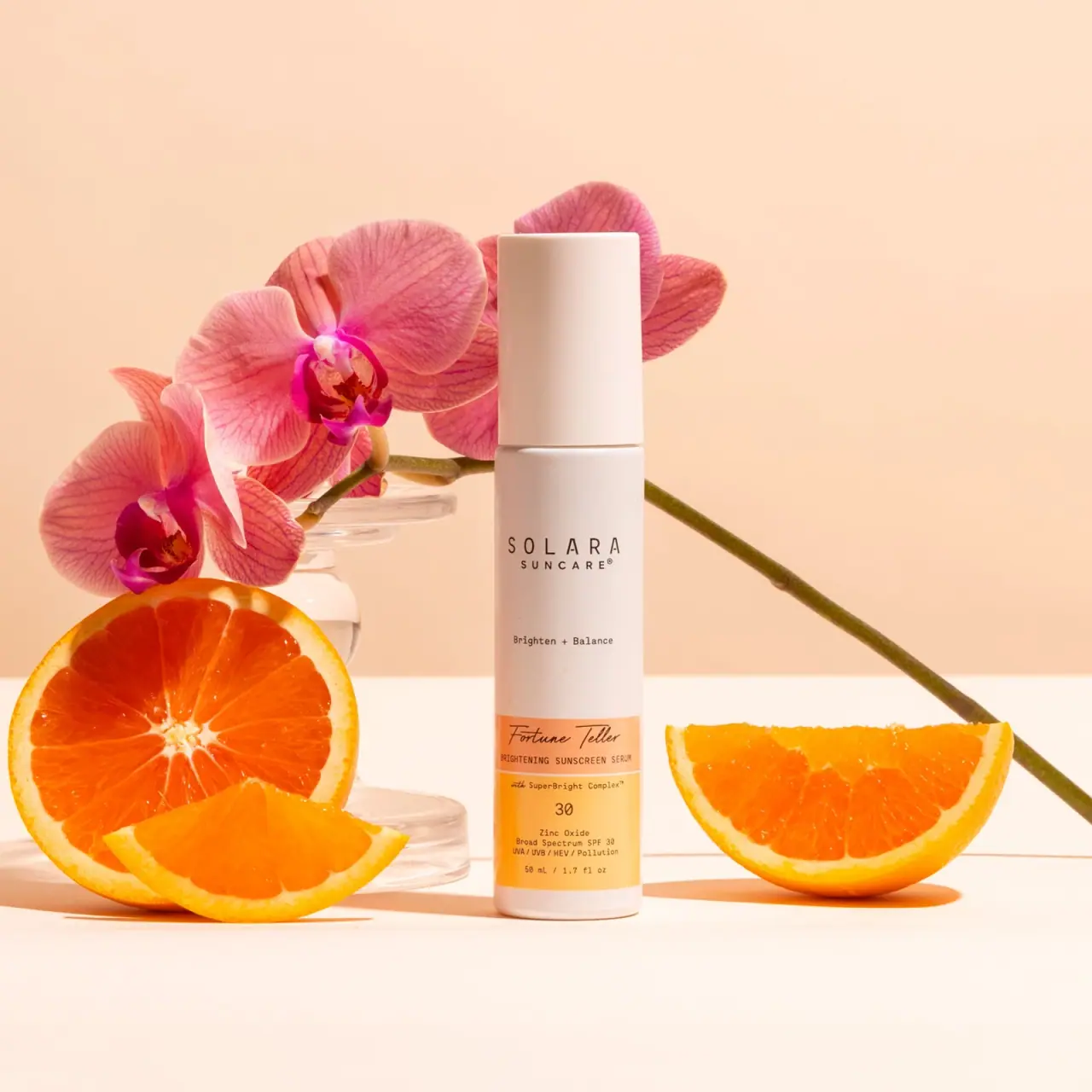
Solara's selected Fortune Teller bottle combines a spacious white upper field with an orange-and-yellow lower information panel. A widely spaced maker contrasts with the cursive product name, while a separate 30 and compact sunscreen facts organise the lower section. The photographed front reads 50 mL / 1.7 fl oz; no specific current MicroTint variant is identified.
The official listing identifies Fortune Teller Brightening Sunscreen Serum SPF 30. The photograph’s white bottle and restrained front are the selected packaging reference.[1]
Pack construction & use
- Bottle and front
- The selected cover shows a white cylindrical bottle with an opaque matching cap and a widely spaced SOLARA wordmark. The official listing identifies the sunscreen serum as SPF 30.[1]
- Product naming and colour panel
- Fortune Teller appears in cursive lettering on an orange strip above a small uppercase sunscreen-serum descriptor. A thin white divider separates this strip from a yellow lower field containing the 30 identifier and compact product facts.Observed in the reference photograph
What makes the design work
Editorial analysis of this packaging reference.
Whitespace frames the wordmark
The spaced SOLARA logo occupies a small upper area, surrounded by an open white field. This makes the front read cleanly even when the product is photographed at a distance.
Variant name adds character
FORTUNE TELLER gives the restrained bottle a more memorable verbal cue, while the smaller sunscreen-serum text explains its product category. The label can therefore stay minimal without losing clarity.
Simple cylinder suits the set
The bottle’s upright cylindrical form creates a calm vertical anchor. The design’s impact comes from spacing and naming rather than a complex silhouette or decorative surface.
Ideas for your next brief
- Use generous whitespace around a wordmark when the bottle shape and color already establish the product family.
- Give a distinctive variant name a clear hierarchy above the functional product descriptor.
Sources & further reading
Researched 19 October 2026