About this packaging
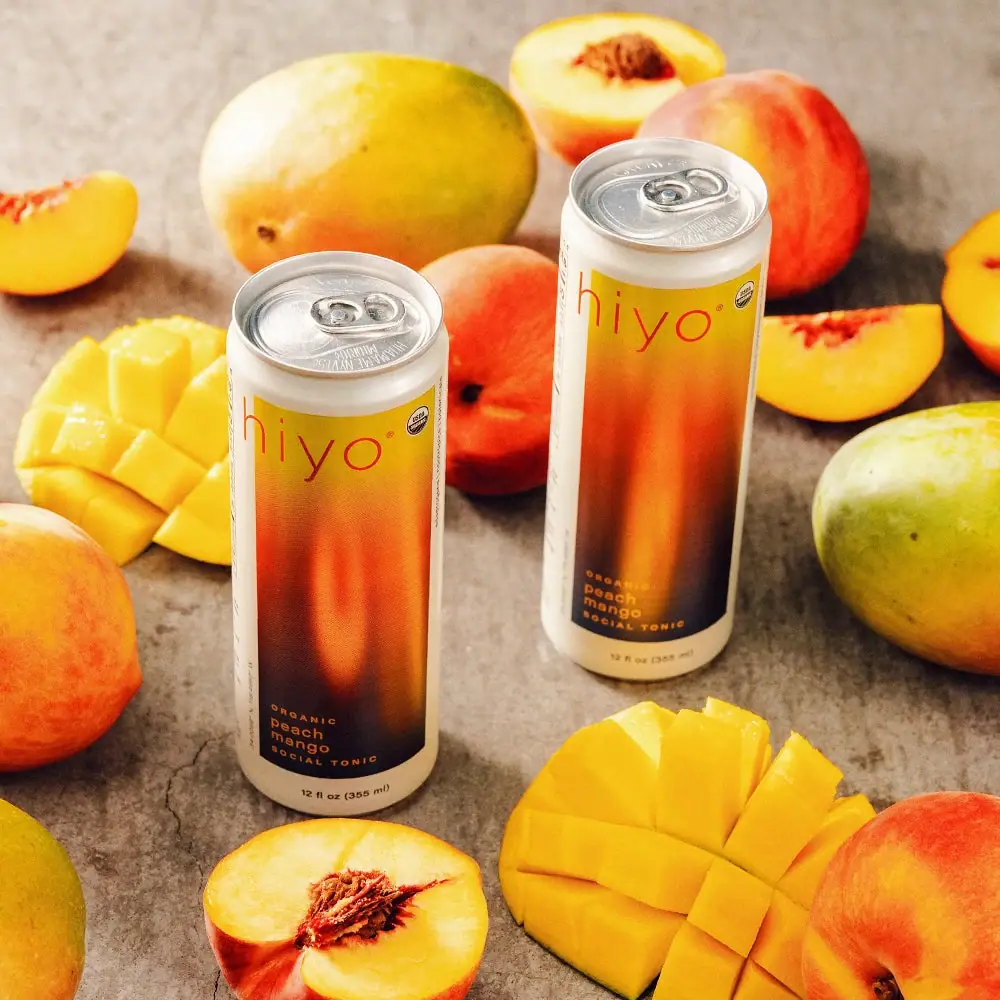
Hiyo’s Peach Mango social tonic uses a slim can with a cream border framing a saturated fruit-color gradient. The selected campaign image repeats the flavor’s peaches and mangoes around the can, making the color field and ingredient cues work together.
Hiyo’s official page identifies Peach Mango as a non-alcoholic social tonic and presents the product in a 12 fl oz can. No material or recycling statement for the can was identified in the opened source.[1]
Pack construction & use
- Can format
- The official product image and selected cover show a slim cylindrical can with pale top and bottom bands. A cream border frames a tall gradient panel on the body.Observed in the reference photograph
- Flavor identification
- The lowercase Hiyo mark sits near the top of the color field and the stacked Peach Mango name appears toward the lower part. The product descriptor is placed below the flavor.Observed in the reference photograph
What makes the design work
Editorial analysis of this packaging reference.
A gradient carries the flavor palette
The panel shifts through yellow, orange and deep plum, connecting bright fruit colors to the can’s tall vertical form. The cream frame keeps the saturated field contained and visually distinct.
Small type creates a relaxed hierarchy
The fine lowercase wordmark does not overpower the composition. The flavor is stacked in short lines near the base, allowing the gradient itself to provide the immediate visual signal.
Whole fruit supports the color cues
Peach halves and mango pieces surround the two cans in the selected image. Their natural colors echo the printed gradient while the pale cans remain distinguishable from the photographic background.
Ideas for your next brief
- Use a bounded color panel to give a slim cylindrical pack a strong, recognizable face.
- Stack short flavor names to fit a vertical layout without enlarging the type beyond the brand system.
- Echo a package gradient with real ingredients in campaign imagery for flavor clarity.
Sources & further reading
Researched 19 October 2026

